
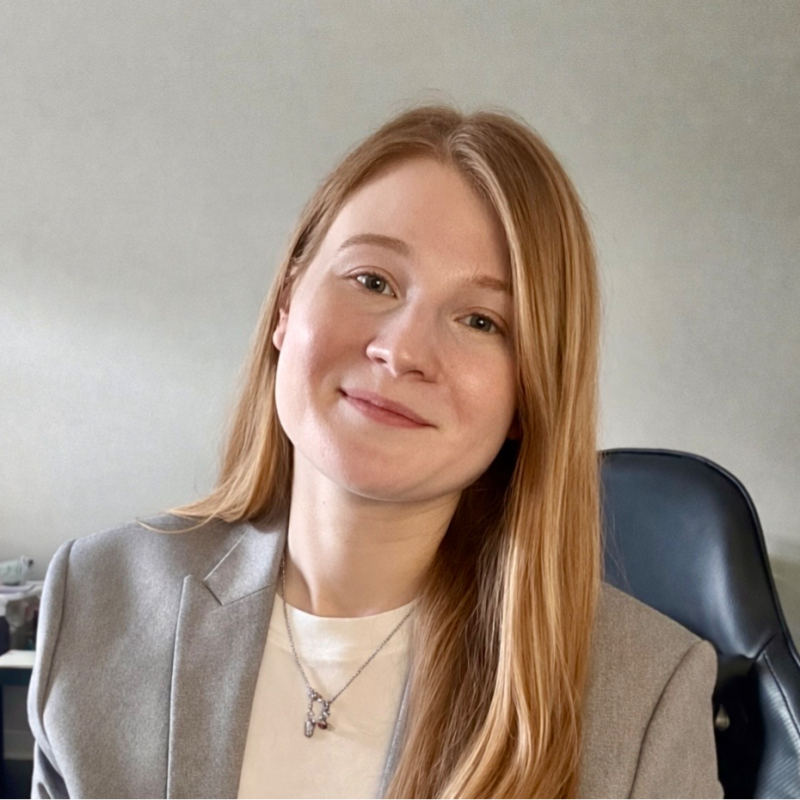
Anastasia's background is in EdTech and education, work she built over years in a large international ad tech company, alongside tutoring in ESL. Before her life folded into constant movement, her days had a rhythm: a full shift at work, then a bus ride to dance training, where she led a team and learned new choreographies for the projects that always seemed to be stacking up.
Before America
She is originally from Odessa, Ukraine, a place she still calls the best on earth. In 2022, everything changed. She left Odessa for Poland, then Germany, where she met her husband, who was finishing his bachelor's degree there. They weighed staying in Germany against moving to the United States, and chose the US. Before that decision landed, she'd also spent time living in Thailand.
“In 2022, I moved to Poland first, and then I moved to Germany. And after that, in Germany, I met my husband, and we've decided that moving to the United States made more sense than staying in Germany.”
Ask her for a favorite place and she resists the question. Instead she describes several homes: Berlin, Odessa, and the United States, complicated because inside the US she has already lived in two places, first Arizona, and now Ann Arbor, Michigan, where she is currently based.
The hard middle
Four moves in four years, on top of leaving a country at war, took a toll she doesn't minimize. Getting documents sorted in a new country while processing what had just happened at home was, in her words, incredibly difficult. What carried her through wasn't a single strategy but a stack of long-held habits: dance, a decade-long interest in psychology, and women around her who kept showing up.
“It was incredibly difficult, moving in 2022 after the war started and then moving to another country and getting the documents there as well.”
She points to something specific: for years she worked alone, prized self-reliance, and told herself things were fine. They weren't, not entirely. Having a therapist to talk to, she says, is something people underestimate. Just talking to someone who can hold your experience with empathy can carry you through a genuinely hard stretch.
“I used to work alone a lot. A lot of immigrants, I know, are working also in isolation. And that didn't turn out that well, even though at that time I thought everything was going on in a pretty decent way.”
Where she is now
Anastasia is currently in what she calls a transitional stage, navigating the US job search while contributing consistently to the immigrant community she's part of. She runs and shows up for English Speaking Club sessions, a space with a Toastmasters-style format and an open-topic format, both built so women can practice speaking without judgment, even after a day spent job hunting or caring for kids.
Her own relationship with English started at age four, shaped by her mother and a cousin who had moved to the US and encouraged her to keep learning. She now speaks Ukrainian, Russian, and English, and is learning Korean, having picked up some Japanese as a teenager through anime before shifting to Korean dramas and culture. She's candid that fluency took more than exposure: acquisition, real output, and interaction with people mattered as much as any TV series ever did.
“It has to be acquisition. You have to care about the environment, you have to care about input, and you must not forget about correct output and interaction with people.”
Her psychology background isn't casual interest, either. She underwent professional training in methods including psychoanalysis and transactional analysis, and it shapes how she thinks about immigrants navigating hard transitions: identify what made your past life joyful, and find a way to install those things back into your current one.
What's next
She wants to get familiar with US corporate learning and development, the field she worked in before, and is considering going back for a degree to deepen that knowledge. Longer term, she wants to study psychology further and pursue a master's in it. Her mother's lesson stays with her: investing in yourself and your education is always worth it, even without funds up front, since organizations exist to help immigrants get there.
“Redefining yourself can actually give you more opportunities in the future than you are aware of now. So being open to new challenges, maybe something like that.”