
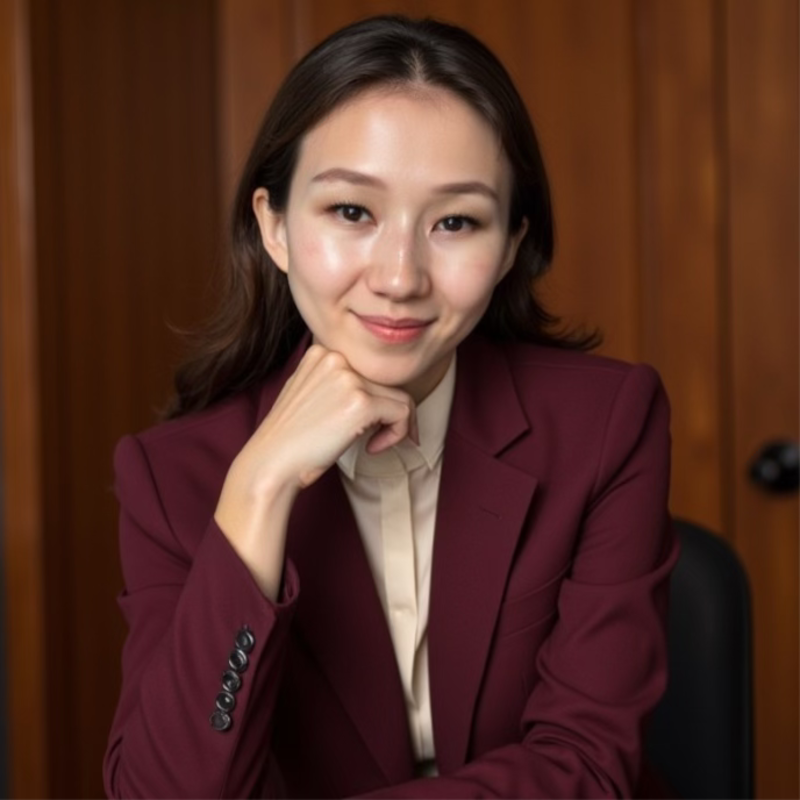
Before America
Gaukhar grew up in Kazakhstan, comfortable and cared for. "My parents did everything for my comfort," she says. "I never actually lived my beautiful comfort life." But since she was seventeen or eighteen, she had been in love with Korea, drawn in through K-dramas and K-pop, dreaming of a country she'd never seen. In 2015, at twenty-two, fresh out of university, she decided to test that dream. She told herself it would be six months.
Those six months turned into more than six years. She learned Korean while working part-time jobs to survive, nearly gave up and moved home during the hard first two years, then won a scholarship in 2019 to pursue a master's in international relations: a degree she would never actually use in her career. It was during her master's, in the middle of COVID, that she stumbled into a fintech startup, first doing customer support, then moving into product marketing. "I literally loved what I was doing there," she says.
“From naive girl, I kind of grew to a person that fights for herself. I love that experience but it was very hard and challenging.”
The startup thrived, and so did she, but her visa didn't follow. The company couldn't sponsor her, so she had to job hunt again from inside Korea's hierarchical, conservative corporate culture, foreign and female in a system built for neither. "You become like a lawyer for yourself," she says of navigating visa sponsorship alone. "You become like everything for yourself."
Arriving, and arriving again
By 2023, burnt out from years in Korean corporate life, Gaukhar and her husband relocated to Singapore, where she joined a pre-seed startup building products for the Southeast Asian market. There was no structure to lean on, so she had to build everything from scratch alongside three founders. Singapore's culture was gentler on the surface, English-speaking, less rigidly hierarchical, but she still had to relearn the psychology of a new market from the ground up. "One year of working in a startup would be like three years working in a normal company," she says.
In February 2025, she moved again, this time to the United States, joining an American startup to build a pre-product-market-fit product. It was her fourth country in a decade, and the cultural shock was immediate, not just in her career but in daily life. In Kazakhstan and Korea, she'd been raised to let results speak quietly. In America, silence gets you nowhere.
“Here in the US, you have to talk about yourself. If you are not talking about your achievements, no one is going to know about you. This is how you actually stay visible in this country.”
Posting about her own work on LinkedIn felt like violating a rule she'd carried her whole life. "It's like this imposter syndrome I have: it just started to protest inside me," she says. "No, don't talk about yourself." She had to unlearn a decade of instinct to survive in a country that rewards self-advocacy.
The hard middle
The pattern across every country was the same: fear of being seen as replaceable pushed her to overwork. In Korea, insecure about being a foreigner taking a local's job, she ended up doing the work of three or four people at once, on top of studying. "I was in a fear that I would lose my job. I'm an immigrant, I'm a foreigner," she says. She lost weight from the stress and burned out.
“I ended up in a situation that I was doing the work of four people. I burnt out. I lost a lot of weight because I was getting a lot of stress. You don't do that. Always know your worth.”
Reflecting on nearly a decade of moving (six years in Korea, a year in Singapore, a year and a half in the US), she describes something close to grief for lost time. "The last ten years went through very fast, but at the same time I don't remember that I was actually enjoying it," she says. "I was depressed and I kind of lost myself. I had the crisis of the immigrant, I'm sure everyone has it."
Where she is now
Today Gaukhar is building an early-stage product in the US, navigating pre-product-market-fit territory with a team she trusts, something she says has mattered in every country she's worked in. "Whenever you say 'I build a startup,' you cannot say I build a startup. I always say we do it, we do it as a team," she says. Distribution, not building, is now the hard part; AI has made it easy to build almost anything, but reaching the right audience remains the real challenge.
She's also, for the first time, trying to build differently: with discipline instead of self-erasure, with visibility instead of silence, and without the three-jobs-at-once pace that defined her twenties. She's starting over completely in the US, with no American education, no American work history, no family here beyond her husband's, but she's doing it with more self-knowledge than she had at twenty-two in Seoul.
What's next
Gaukhar wants to build a successful business of her own. She already has what she calls "a graveyard of startup ideas" and experiments from the last few years, some working, most not, and she has no plans to stop trying. But her real ambition has shifted. She wants a balanced life: enough time for her family, enough room to keep growing her career, without disappearing into performance the way she did for the past nine years.
“I don't want to live like this anymore. I want to have a balanced life, where I'm building my family here, I have enough time to spend with my family, and I have enough time to grow my career.”